I. Theoretical Framework: When the Buffer Thins to Zero
Peter Turchin describes secular cycles as follows: expansion → elite overproduction → exhaustion of the resource buffer → crisis. When a system consumes its margin of safety, it searches for a new valve — or breaks. Carlota Perez adds a second lens: every technology follows an S‑curve — installation → frenzy → turning point → deployment → maturity.
All three classical protein buffers of the 20th century — soybean meal, fishmeal, rendering — have already passed through their S‑curve and hit the maturity phase, where growth comes in fractions of a percent and the resource ceiling is visible to the naked eye. The fourth buffer revolution begins at the moment when the old buffers can no longer hold the pressure, and a new one reframes the problem, shedding the old regime's drawbacks.
Black Soldier Fly (larval meal) — the fourth protein buffer, untethered from land, ocean, and livestock numbers. The valve that opens it is the convergence of three conditions: a regulatory window, corporate demand, and technological readiness. This brief shows why that valve has already been turned.
II. How the Buffer Works: Meat as a Byproduct, Buffer as the Main Business
Global meat production grew from 71 million tonnes in 1961 to ~365 million tonnes in 2024; compound feed — $550–655 billion today with a forecast of ~$990 billion by 2034. Demand for protein does not stop, but the distribution of margin in the system has long been inverted.
A fact that everyone knows and almost no one says aloud: meat giants do not make money on meat. The operating margin of the meat division at Tyson, JBS, Marfrig is 0–2%; Tyson Beef in 2025 shows −$426 million EBIT. The animal body as a product for humans is a conveyor with minimal margin; the main source of profitability is the byproduct buffer.
Byproducts — bones, blood, fat, offal — generate 7–13% of revenue and up to 40–60% of gross margin for a meat company; rendering converts them into meat-and-bone meal, fat, blood meal. The planet's largest meat-packer loses money on meat. It earns — on bones.
The circular chain looks like this: livestock → slaughter (margin 0–2%) → byproducts (40–60% margin) → rendering (~$23.5 billion) → meat-and-bone meal → compound feed for poultry and swine (~40–45%, CAGR 1–2%), pet food (~15–20%, CAGR 6–7%), aquaculture (~8–13%, CAGR 5–6%), specialty feed (~5–10%) → aggregate demand growth for meal ~3–4%/year with supply growth ~1–1.5% → structural deficit → price increases. Livestock feed has already maxed out the base; pet food and aquaculture are finishing off the strained balance. Meat, in this scheme, is the byproduct — the offal buffer is the business.
III. Land, Ocean, and Livestock: Three Ceilings Already Hit
Approximately 71% of habitable land is occupied by economic activity; ~50% of the surface is devoted to agriculture, and 77–80% of that land serves animal husbandry — pastures and feed crops. Only a fifth of agricultural land feeds humans directly.
Arable land per capita has fallen from 0.46 ha in 1950 to 0.19–0.217 ha today — a 2–2.4× decline; 90% of the remaining reserve is concentrated in seven countries where every hectare runs into forest and politics. Expansion requires deforestation: from 2001 to 2015, ~45 million ha of forest were destroyed for pastureland — the area of Sweden.
Animal farming is approaching the biological limit of FCR: broiler — 1.6:1, salmon — 1.2:1. There is almost nothing left to squeeze from genetics. Compound feed production grows at ~1.2% per year, the meat complex adds 1.1–2% — this is the ceiling of a system tied to land. Aquafeed grows faster (~4–5%), but the share of fishmeal in it is falling — the ocean cannot give more. Land ceiling = feed base ceiling = livestock ceiling = byproduct buffer ceiling
IV. Three Old Buffers: How Byproduct Streams Became Infrastructure — and Hit the Ceiling
1. Soybean Meal: The Buffer on Arable Land
Soybean meal started as a byproduct of oil extraction; in the 1920s–50s it was a surplus stream that needed to go somewhere. The explosive growth of poultry farming turned it into a standardized feed protein, and today 67–70% of the world's soybean meal goes to feed.
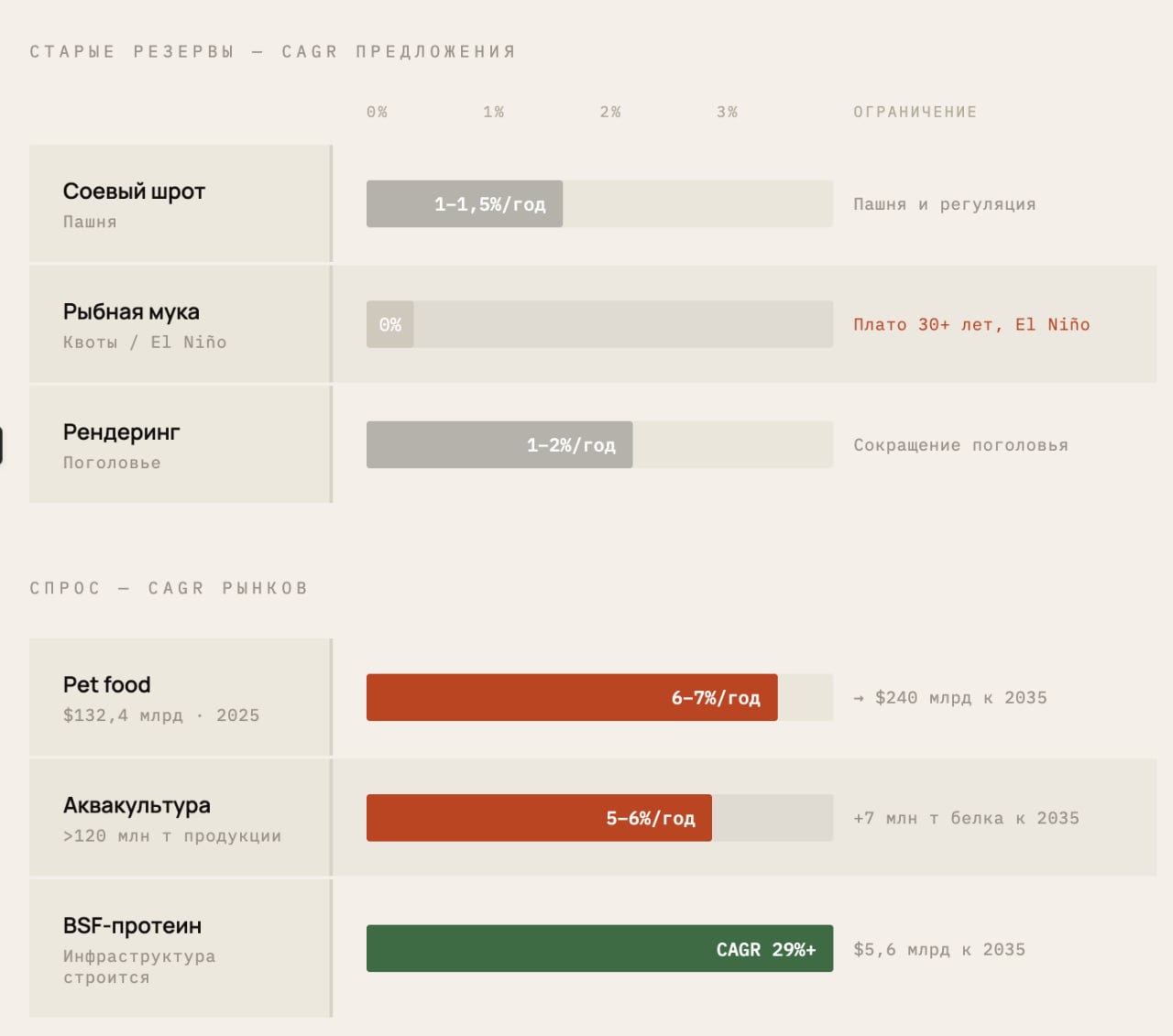
The ceiling here is arable land and politics: 90% of global soy exports are controlled by the USA, Brazil, and Argentina; expansion is possible mainly through deforestation, which is restricted by the Amazon Soy Moratorium and EU deforestation regulations. Arable land per capita has halved compared to the 1950s, soy supply growth is 1–1.5% per year, while fast-growing segments — aquaculture and pet food — are increasing demand for feed protein by 5–7%, pulling meal away from poultry farming.
Risks: the drought in Argentina 2022–2023 crashed the soy harvest by 45% — from 44 to 25 million tonnes in a single season. La Niña, floods in Brazil, heat in the US Midwest — three countries control 80%+ of exports, and every weather hit on any of them strikes global meal prices. Logistics add fragility: the shallowing of the Paraná in 2021 blocked barges with Argentine soy for weeks. And it is not only nature that can block straits. A buffer tied to three jurisdictions and a single harvest season is a bet on the weather — and a fragile one.
2. Fishmeal: The Buffer on Quotas
Fishmeal grew from processing non-standard catch into a standard compound feed ingredient, and then — the main protein component of aquafeed. Since the early 1990s, production has held at a plateau of 5.4–5.6 million tonnes per year — for over 30 years now. Fish catch directed to meal processing fell from 35 million tonnes in 1989 to ~17 million tonnes by 2022; the gap is closed by processing byproducts.
According to IFFO data, 39% of global fishmeal and 54% of fish oil are produced no longer from whole fish but from heads, backbones, and other remnants. Peru provides ~20% of global fishmeal; El Niño in 2023 completely cancelled the first season, with losses of approximately $1.4 billion, and the second season was closed early. At a fishmeal price of around $2,000 per tonne, this stream is transforming from a buffer into a bottleneck.
3. Rendering: The Buffer Tied to the Herd
Rendering is one of the oldest recycling businesses: trimmings and fats were rendered for fats and protein fractions long before it became ESG language. In the 20th century, the shift to large meatpacking plants concentrated all byproducts in one place and made affordable industrial meat possible.
Today, in North America alone, ~28–31 million tonnes of byproducts are processed, yielding ~8.9–10.7 million tonnes of protein and fat ingredients with growth of 1.7% per year. The distribution for meal is roughly: poultry and swine — 40–45%, pet food — 15–20%, aquaculture — 8–13%, specialty feed and fertilizers — the rest. The fat fraction goes in a separate stream — more than half is already taken by biofuel.
Meanwhile, pet food grows at 4.5–7% per year with a market size of $132.4 billion in 2025 and 900 million pets worldwide, while the rendering stream grows at 1–2%. The US cattle herd stands at 28.2 million head, the lowest since 1952; Tyson is closing a plant in Nebraska (3,200 workers, ~5% of daily slaughter), booking a $426 million loss. The buffer is shrinking along with the herd.
And this is without accounting for tail risk: avian influenza H5N1 in 2022–2024 destroyed >100 million head of poultry in the US and EU alone; ASF in 2018–2019 wiped out ~25% of the global pig herd — almost entirely in China. Epizootics are not forecast, not contained in time, and strike entire countries at once: borders close, exports halt, sanitary zones block logistics for months. Every outbreak is not just meat — it is a collapse of the byproduct stream: no herd — no bones — no meal. Rendering as a buffer inherits all the biological risks of animal husbandry — including those impossible to factor into a model.
V. Diagnosis by Turchin: A System at the Resource Ceiling
Complex systems hold on until the last moment, then break abruptly. As long as a buffer exists, pressure dissipates. Once it is exhausted, a phase transition begins. In the feed industry, "elite overproduction" per Turchin is the overproduction of premium segments competing for the same unchanging stream: Chinese and Norwegian traders fight over the same Peruvian anchovy at triple the price.
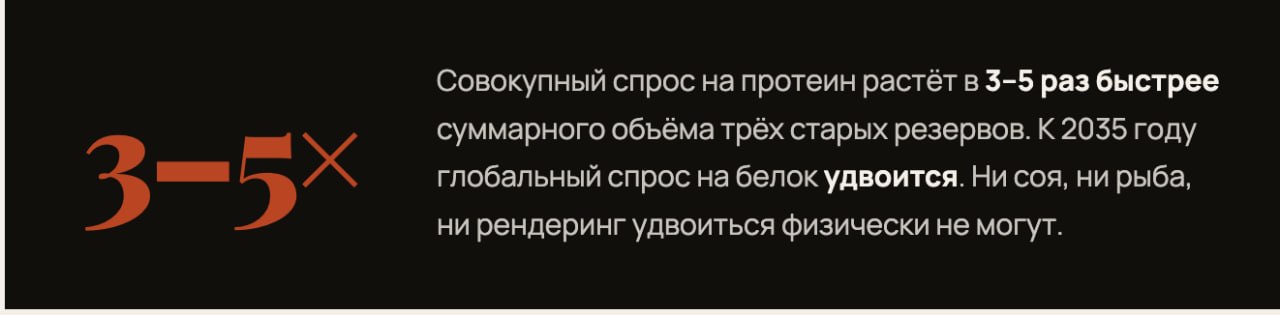
Demand (CAGR): pet food — 4.5–7%, aquaculture — 5–6%, livestock — 2–3%. Buffer supply: soy and meat — 1–1.5%, fish — 0%. Aggregate protein demand grows 3–5× faster than the combined volume of the three buffers; by 2035, demand for feed protein will grow by 40–50%, but none of the buffers can add that much.
VI. The Asymmetry of the 21st Century. The System Produces a Massive Energy Stream — and Lets It Rot in Landfills
Against the backdrop of old reserves' exhaustion, the system continues to generate a colossal volume of organic products that find no place in the processing chain. Annually, ~940 million tonnes of industrial organics go to landfills. A third of all food produced is never eaten — ~1.3 billion tonnes of food losses. Cities produce ~2 billion tonnes of solid waste, half of which is organic.
This is not "waste." This is energy and nutrients that the system produced but could not digest. In landfills, they turn into methane — the third-largest anthropogenic source of this gas, with a warming potential 80 times higher than CO₂ on a 20-year horizon. By 2050, the volume of organic waste will grow by another 70%.
The system is drowning in raw material it cannot digest. In the terms of the old economy, this is a disposal cost. In the terms of the new one — a feedstock base whose potential has not yet been developed into protein infrastructure.
VII. BSF as a New Institution: An Ocean of Industrial Organic Streams
Black Soldier Fly (Hermetia illucens) — the first candidate for the fourth protein buffer, whose "arable land" is not hectares or quotas, but organic streams that the system currently considers costs. I am talking only about industrial organics: factories, the agricultural sector, large-scale HoReCa, markets, agro-hubs, alcohol producers (stillage, BSG)
Standardized conversion model: 100 tonnes of industrial organic substrates at 70% moisture yield ~18 tonnes of live larvae. Of these — ~3.6 tonnes of protein meal (protein 50%+, low ash) and ~1–1.5 tonnes of fat (rich in lauric acid). In parallel, frass is formed — an organic fertilizer that closes the cycle in soil.
In essence, the black soldier fly performs the same function as poultry or fish: it converts organics into high-quality animal protein and fat. But the input substrate is not grain or fish, but what found no place in the processing chain. The fly does not compete with humans for food — it finishes what humans no longer need.
VIII. Functional Biology Instead of "Kilograms of Protein"
Counting BSF only in dollars per kilogram of protein is a methodological error: BSF simultaneously delivers three functional layers.
Protein. 50%+ of highly bioavailable protein with a complete amino acid profile. Replacing fishmeal with BSF components up to 50–75% in tilapia and trout diets does not reduce weight gain; at 100% replacement, losses are minimal and compensated by improved survival and gut health.
Antimicrobials. Lauric acid (C12) — a natural antimicrobial factor. In poultry and swine farming, the BSF component reduces pathogenic load of E. coli and Salmonella by 40–55%, enhances Lactobacillus and Bifidobacterium — without antibiotics.
Prebiotic. Chitin diversifies gut flora and enhances immune response. For pet food — a hypoallergenic novel protein: clinical protocols on dogs with dermatitis show improvement in skin condition when switching to BSF diets.
IX. Thailand as a Testing Ground: The Economics of Industrial Streams Only
Thailand generates ~27 million tonnes of waste per year, of which 10–12 million tonnes are organic, and 3–4 million tonnes are uniform industrial organic streams suitable for BSF. We use only this industrial substrate and standard conversion.
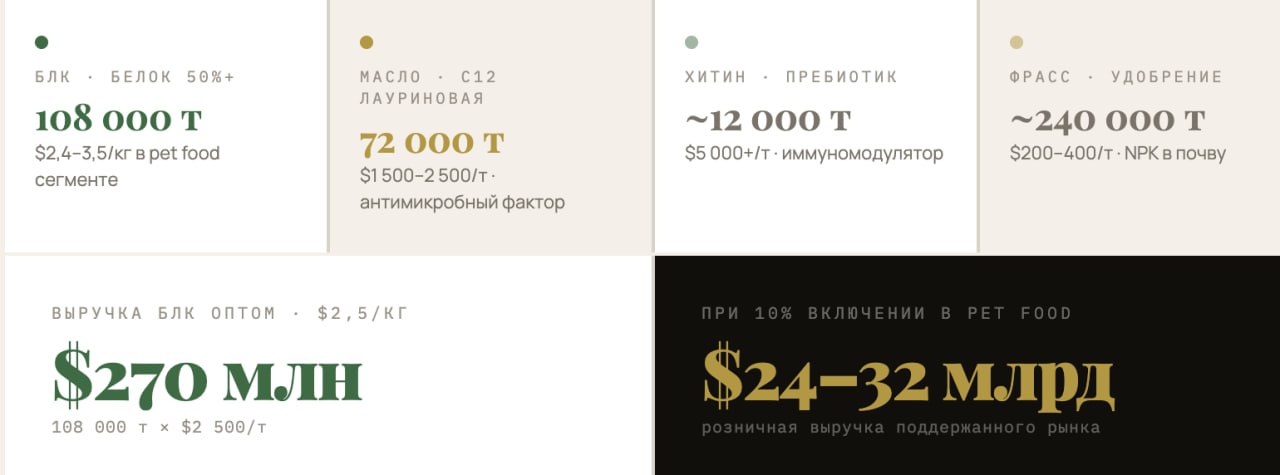
BSF factories in this configuration should logically be located where these streams are already accumulated: food industry clusters, agro-hubs, beer producers — this reduces logistics and provides a stable, chemically uniform substrate.
Rough calculations for potential production sites at the link https://mistf.com/en/bsf-farm-thailand
X. Pet Food and Aquaculture: Who Pays for the New Buffer First
Pet food — a $132.4–152 billion market, premium segment ~$40 billion today and ~$69 billion by 2035. The insect-based pet food market — ~$1.6 billion with a forecast of up to $4.15 billion by 2035, growing twice as fast as the main feed market.
In high-income countries, millennials and zoomers are adopting corgis instead of raising children — and feeding them better than themselves. 71% of US households have pets; for pet parents, diet is not feed — it is insurance: hypoallergenicity, gut health, skin, coat. The BSF industry fits the need precisely: protein meal with functional advantages costs ~$2.4–3.5/kg, while precision fermentation remains at $8–13/kg.
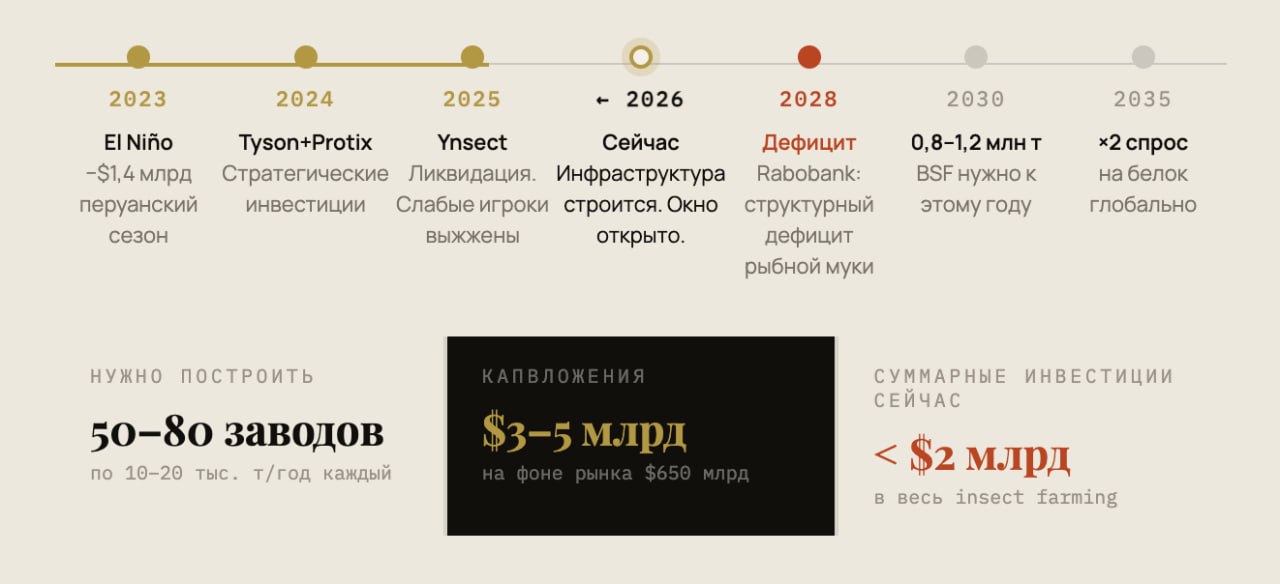
Aquaculture grew from <10 to >120 million tonnes in 40 years; demand for protein ingredients for aquafeed — ~7 million tonnes today, ~10 million by 2030 and ~14 million by 2035. Fishmeal is frozen at ~5 million tonnes per year; Rabobank forecasts a deficit as early as 2028. Even partial replacement of 10–25% of fishmeal with BSF components creates an addressable market of $1–3 billion; at the same time, lauric acid and antimicrobial properties reduce the need for antibiotics.
XI. Investments and the S‑Curve Phase: Between Hype and Infrastructure
The global insect protein market is estimated at $0.76–1.01 billion (2024–2025) with a forecast of up to $3.96–10 billion by 2033–2035 at a CAGR of 25–40%. The BSF market separately — $0.44 billion with a forecast of up to $5.6 billion by 2035 and a CAGR of 29%. At the same time, total investments in the entire insect farming sector are less than $2 billion; approximately 36% of capital went to companies that have already ceased operations or entered restructuring.
Ÿnsect, which invested >$600 million in mealworm with a slow cycle and grain as substrate, ended up in liquidation by 2025. This is not "insect failure" — it is the wrong species and the wrong substrate. BSF, which runs on industrial organic streams and generates four revenue streams (protein meal, fat, chitin, frass), remains at the beginning of the deployment phase: technologies are proven, weak players have been shaken out, infrastructure has not yet been built.
To bring BSF ingredient production to 0.8–1.2 million tonnes by 2030 and cover at least part of the deficit in pet food and aquaculture, 50–80 large factories with a capacity of 10,000–20,000 tonnes/year each and total capital investments of $3–5 billion will be required. Against the backdrop of a $550–655 billion feed market and a future $990 billion, this is a volume that determines not the size of the market, but who will become the operator of the new infrastructure.
XII. Competing Technologies: Why BSF Is a Buffer, Not a Niche
Precision fermentation, single-cell protein, microalgae, and cultivated meat form the landscape of alternative proteins, but their entry logic is different.
- Precision fermentation is growing rapidly (CAGR ~25%) but targets human food and premium pet food with a cost of $8–13/kg and dependence on sugar; it is a competitor to BSF in the functional premium segment, but not in mass aquafeed.
- SCP yields 60–70% protein and uses CO₂/H₂, but requires complex purification and high CAPEX; its strong position is Northern Europe, while BSF wins where there is heat and organics.
- Microalgae are excellent at delivering omega‑3 for aquaculture but are limited by light and cost, so they complement BSF rather than replace it.
- Cultivated meat is aimed at humans and does not work economically in feed.
What distinguishes BSF is not only biology but also the entry architecture: the input feedstock is a system obligation (industrial organic streams) at a market, zero, or negative price, not a competing asset. In this sense, BSF is not "yet another protein" but a new buffer institution, decoupled from land, ocean, and livestock numbers.
XIII. The Numbers
BSF protein is the only animal protein whose growth base is already-produced but unclaimed organic products, rather than new hectares or additional catch quotas. It plugs into the same channels as the byproduct buffer (feed, aquaculture, pet food, oleochemistry) but relies on a feedstock base that has not yet been capitalized.
The window of 2024–2028 is the moment when:
- old buffers are already demonstrating structural limitations (fishmeal ~$2,000/tonne, a declining cattle herd, regulatory ceilings on soy),
- BSF technology is proven, the first large-scale projects (Tyson+Protix, Cargill+InnovaFeed) are already being built, but infrastructure is far from saturation,
- total investments in the sector remain below $2 billion — an order of magnitude less than what it would cost to build a full-scale global buffer.
The fourth buffer revolution does not promise to abolish the laws of biology or economics; it proposes to redistribute the system's energy potential, shifting the center of gravity from herds and catches to industrial organic streams.
XIV. The Buffer Is Dead — Long Live the New Buffer!
The three protein buffers of the 20th century hit the ceiling: soy — arable land and weather, fishmeal — quotas and ocean, rendering — herds and pandemics. Each of them started as a byproduct, became infrastructure — and exhausted its S-curve. Aggregate demand for feed protein grows 3–5× faster than any of them can add. The system per Turchin is at the resource ceiling: the buffer has thinned, the "elites" — pet food, aquaculture, specialty feed — are fighting over the same stream.
Meanwhile, the system annually produces billions of tonnes of organics it cannot digest — and pays for it with methane, landfills, and money. BSF flips the equation: input feedstock is not a competing asset but a system obligation with zero or negative price. Four revenue streams. Not tied to land, ocean, livestock numbers, weather, or livestock disease.
This is not a niche and not a trendy ingredient. This is the fourth buffer — and the valve that opens it has already been turned: technology is proven, weak players have been shaken out, corporations are building the first factories, and infrastructure is an order of magnitude below the need. The window of 2024–2028 determines not "whether BSF will happen" but who will become the operator of the planet's new buffer infrastructure.